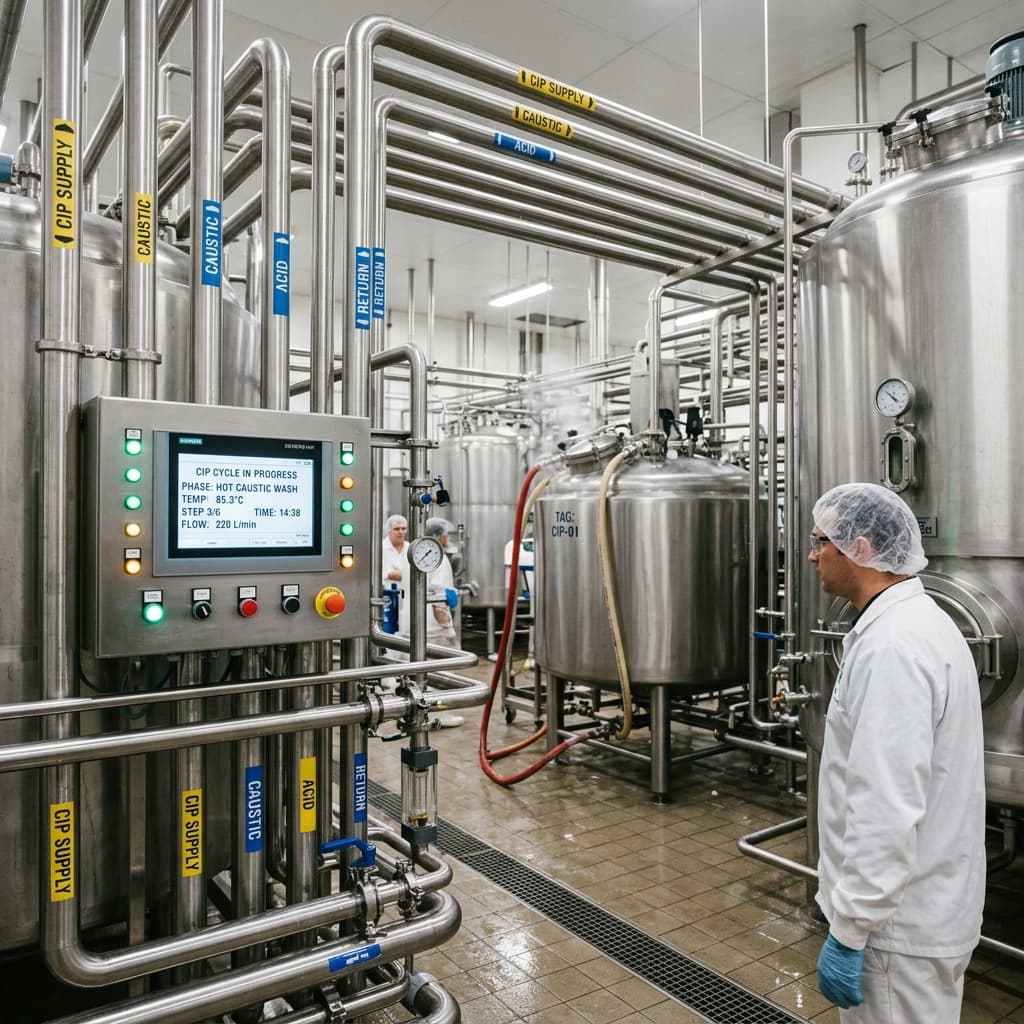
Standards of Industrial Hygiene: CIP and SIP
Cleaning production lines and packaging machines is a vital concern in the food, beverage, dairy, and pharmaceutical sectors. Previously, disassembling machine pipes and tanks for manual scrubbing (Clean-Out-of-Place - COP) was a process that took hours and could not completely eliminate the risk of bacteria.
Today, to meet FDA and GMP standards, CIP (Clean-In-Place) and SIP (Sterilization-In-Place) systems are indispensable parts of packaging lines.
What is CIP (Clean-In-Place)? How Does It Work?
CIP is the process of cleaning the pipes, valves, and tanks of production machinery without dismantling any parts, by circulating water and chemical solutions at high speed within a closed loop.
A standard CIP cycle consists of the following stages:
- Pre-Rinse: Hot water is pumped through to remove coarse contaminants (product residues) from the system.
- Caustic Wash: An alkaline (Sodium Hydroxide) solution is circulated at high temperatures (75-85°C) to dissolve fats and proteins.
- Intermediate Rinse: Clears caustic residues from the system.
- Acid Wash: Nitric or Phosphoric acid (60-65°C) is used to dissolve mineral deposits (scale, milkstone, etc.).
- Final Rinse: The system is completely rinsed with pure water (RO or DI) to remove all remaining chemicals.
What is SIP (Sterilization-In-Place)?
The CIP process removes visible dirt and the majority of bacteria from the machine. However, especially in the filling of products such as UHT Milk, Serum, and Vaccines, the environment must be completely "sterile," meaning all microorganisms (including spores) must be killed.
This is where SIP (Sterilization-In-Place) comes into play immediately after the CIP process. Pure Steam or superheated water—usually between 121°C and 135°C—is pumped into the machine and held for a specific duration (typically 20-30 minutes).
What Does Hygienic Machine Design Mean?
For CIP and SIP systems to be successful, the filling machine must be manufactured according to Hygienic Design (EHEDG standards) rules:
- There should be no dead-legs in the piping. Sharp 90-degree T-junctions where dirt can accumulate should be avoided.
- Surface roughness (Ra) must be below 0.8 micrometers (mirror polish).
- Weld points must be flawless (Orbital welding) and free of cracks.
Frequently Asked Questions (FAQ)
Q: How long does a CIP cycle take and how much water does it consume? A: In traditional systems, it can take 1-2 hours. However, in Dr Mach's smart CIP units, thanks to conductivity sensors that measure chemical concentration in real-time, chemicals and rinse water are recovered (Recovery), reducing both time and water consumption by up to 40%.
For your food and pharmaceutical filling projects subject to stringent regulations, you can rely on Dr Mach stainless steel liquid and cream filling lines, equipped with EHEDG certified components and fully integrated CIP/SIP systems.