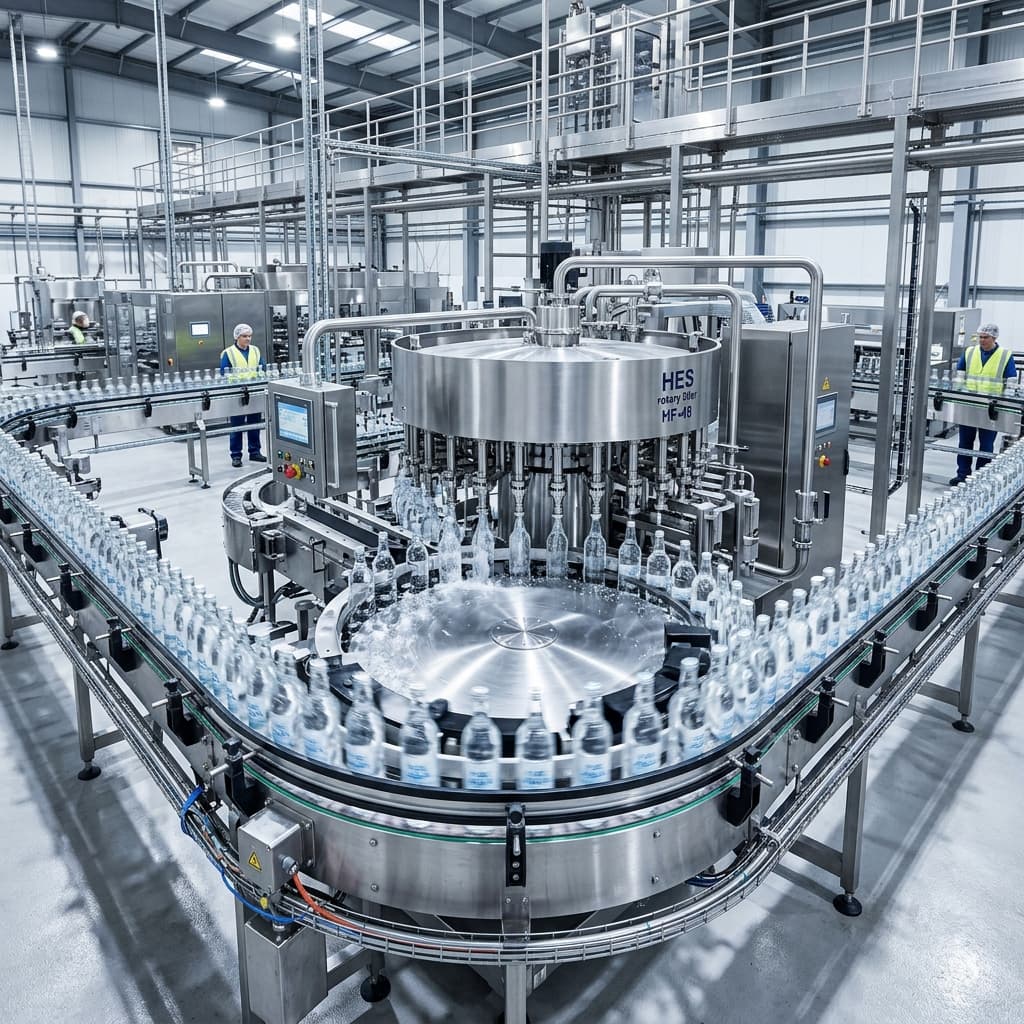
Beverage Bottling Dynamics
In the beverage industry (water, juice, wine, milk, carbonated drinks, etc.), filling liquids into bottles at high speeds (10,000 - 50,000 bottles per hour) and with consistent alignment is vital. Inconsistent liquid levels among bottles on the shelf can devastate a brand's quality perception.
There are two primary methods used in the industry to fill these high-fluidity (low-viscosity) liquids: Gravity Filling and Vacuum Filling.
1. Gravity Filling System
As the name suggests, this system is based on the principle of the liquid flowing into the bottle by its own weight. A large product tank (Hopper) is located at the top of the machine.
- How it Works? When the bottle arrives under the filling valve, the valve opens and the liquid flows from top to bottom. The valve closes once the bottle reaches the desired level (Level-filling).
- Applications: Used for filling non-foaming liquids such as water, juice, vinegar, and milk into glass or rigid PET bottles.
- Advantage: Low cost, easy maintenance, and fast operation.
2. Vacuum Filling System
Vacuum systems operate on the logic of removing the air inside the bottle and using the resulting negative pressure (vacuum) to pull the liquid from the tank into the bottle.
- How it Works? The machine nozzle seals the mouth of the bottle airtight (Seal). The vacuum pump extracts the air from the bottle, and the liquid rushes in rapidly to fill this void.
- Applications: Wine, perfume, olive oil, and certain liqueurs.
- Advantage: Provides flawless level precision. Additionally, if there is a small crack or hole in the bottle (since it won't hold a vacuum), the liquid will not fill that bottle. This allows faulty/cracked bottles to be automatically eliminated (Waste safety).
Foaming Issues and Solutions (Anti-Foam)
Some products, such as milk or juice, foam excessively when poured quickly. This can cause the bottle to overflow or leave an air gap in the capping machine (Capper).
Dr Mach Engineering Solutions:
- Bottom-up Filling: The nozzle descends to the bottom of the bottle, and as the liquid rises, the nozzle moves upward. Since agitation is prevented, foam does not form.
- Angled Spout: Instead of hitting the bottom of the bottle directly, the liquid is sprayed at a slight angle toward the inner wall of the bottle. Because the liquid glides down the wall, foaming is minimized.
Frequently Asked Questions (FAQ)
Q: Which filling machine is used for carbonated (fizzy) drinks? A: For carbonated drinks like cola or soda, Isobaric (Counter-Pressure) filling machines are essential. Before filling, CO2 gas is pumped into the bottle at the same pressure as in the product tank. Once pressures are equalized, the liquid fills the bottle by its own gravity without foaming or losing gas.
Accelerate your production line with our 316L stainless steel liquid filling monoblocks that meet the demanding hygiene (CIP) and high-speed (Rotary) expectations of the beverage industry.