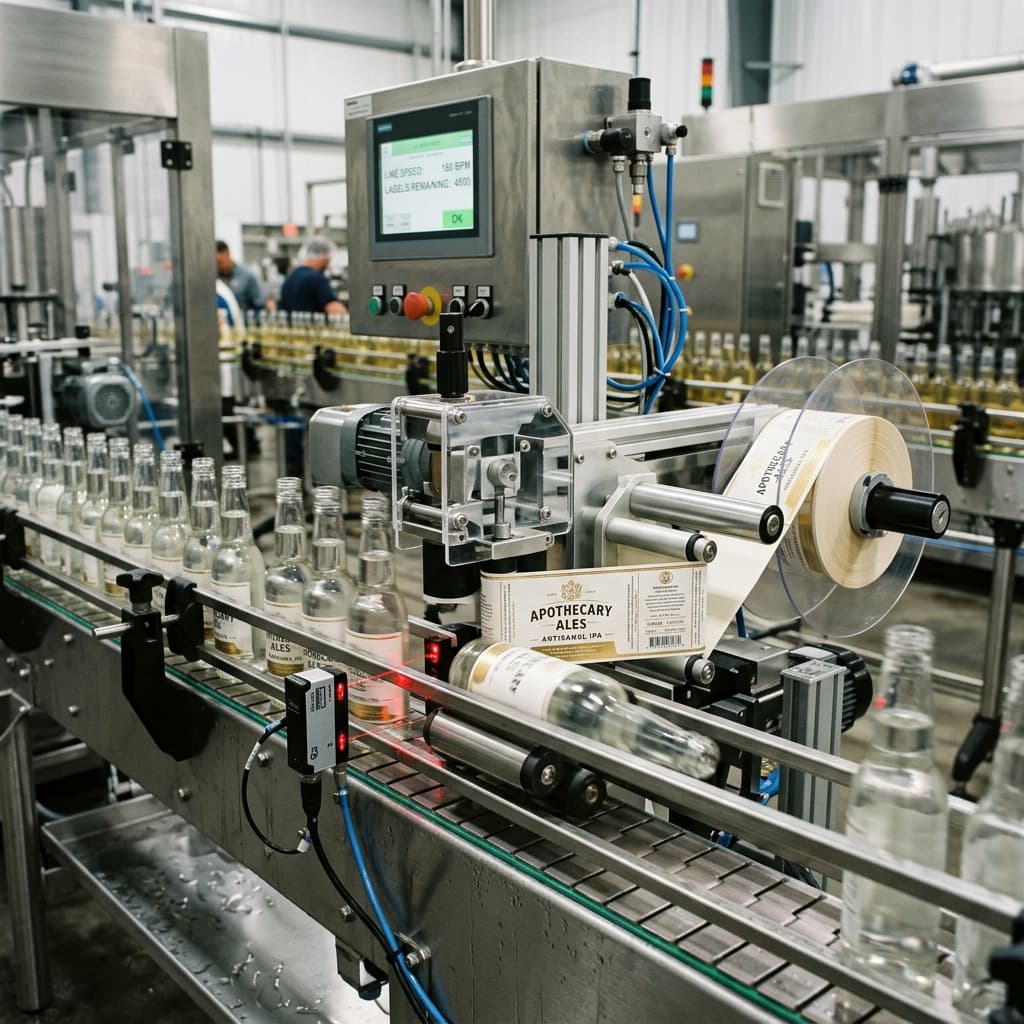
Industrial Labeling: The Face of the Brand
Regardless of how high the quality of a product's formula is, the only thing the consumer sees on the shelf is the packaging and the label on it. A misaligned label, trapped air bubbles, or an unreadable barcode can cause the brand to be perceived as "cheap" or "low quality."
For this reason, Labelling Machines are a critical quality control point in industrial production lines, just as vital as the filling process itself.
Basic Labeling Technologies
Machines are designed differently based on the geometry of the bottle or container:
-
Wrap-Around Labeling:
- Usage: Round bottles, jars, and cans.
- How it Works? As the bottle moves along the conveyor, a self-adhesive label makes contact with the bottle. A sponge wrap belt on the side rotates the bottle around its axis, ensuring the label wraps smoothly in a full circle (e.g., water bottles, peanut butter jars).
-
Front/Back and Side Labeling:
- Usage: Oval, square, or rectangular bottles (Shampoo, engine oil, liquid detergent).
- How it Works? Since oval bottles cannot rotate easily, the machine features two separate dispensers (left and right). As the bottle passes through, labels are applied to both the front and back surfaces simultaneously and smoothed down with pressure pads.
-
Shrink Sleeve Labeling:
- Usage: Sloped, curved, or complex-shaped (such as hourglass) specialty bottles.
- How it Works? The label is not adhesive; it is a plastic "tube/sleeve." The sleeve is slid over the bottle from the top. The bottle then passes through a Steam Tunnel. With the heat of the steam (approximately 85-90°C), the plastic sleeve shrinks, adhering perfectly to all curves of the bottle in 3D (e.g., Ayran, fruit yogurt drinks, energy drinks).
Tamper-Evident Bands
According to food and pharmaceutical safety standards, it must be proven that a product has been "opened for the first time by the customer" after leaving the factory. Shrink sleeve machines apply a small shrinkable sleeve (Tamper-evident band) over the cap to lock it in place. When the user opens the cap, the sleeve tears, thereby preventing security breaches.
Frequently Asked Questions (FAQ)
Q: How do sensors detect transparent labels? A: Standard optical (light) sensors cannot read the gaps in transparent (no-look) labels. To apply these luxury transparent labels seamlessly, Capacitive Sensors or Ultrasonic sensors must be installed on the machine. (The sensor measures based on the thickness of the label rather than light).
Q: What is the difference between Hot-melt (Glued) and Pressure Sensitive (Sticker) labels? A: In hot-melt systems, the label paper or OPP film comes off the roll without adhesive. The machine applies hot glue to bond it to the bottle. In high-capacity water lines (20,000+ per hour), this is extremely cost-effective. Sticker labels are more expensive but provide a premium appearance for products like cosmetics and wine.
As Dr Mach, we offer smart labeling systems with servo motor control that apply labels with $\pm$1mm precision up to 300 bottles per minute, equipped with barcode verification (Vision Control) cameras.