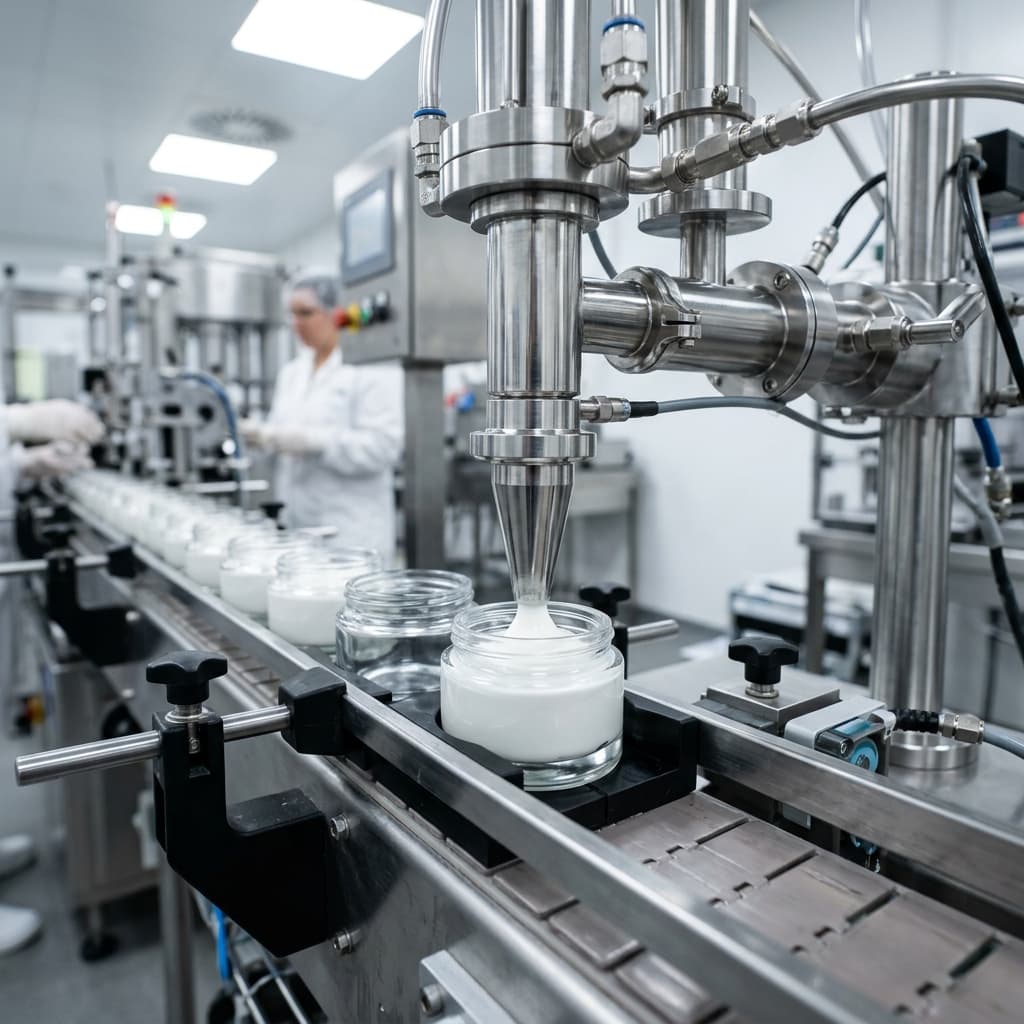
Why is Viscosity Important in Cosmetic Production?
The cosmetic industry has a very wide range of products. From highly fluid perfumes like water to thick, honey-like creams, and even gel products with micro-beads (peelings), many different structures exist. These different structures are measured by viscosity (resistance to flow) and this directly determines the type of filling machine required.
Wrong machine selection can disrupt the molecular structure (emulsion) of the product or cause fluctuations in filling weights.
Best Filling Technologies for Creams and Lotions
In the cosmetic sector, these two pump types are generally used:
-
Lobe Pump Filling:
- Usage Area: Thick creams, jellies, peeling gels.
- Why Preferred? Lobe pumps push the liquid gently (Low Shear). This way, the formula of creams with air bubbles or sensitive emulsion structures is not disrupted.
- Advantage: Fills without crushing the particles inside the product (e.g., peeling beads).
-
Volumetric Piston Filling:
- Usage Area: Liquid soap, shampoo, body lotion.
- Why Preferred? It draws the product into the piston cylinder with a vacuum and presses it into the bottle with high pressure.
- Advantage: It is the technology with the highest precision in milliliters (ml). Works with ±0.5% deviation.
Use of "Heated Hopper" in Cosmetic Filling
Vaseline, pomades, or thick hair masks lose their fluidity and freeze at room temperature. To fill these products, the machine's hopper must have a Double-Jacketed heating system and an agitator (mixer). The heated product becomes fluid, mixes homogeneously, and is bottled seamlessly.
Dr Mach offers 100% precision for your high-viscosity products with our cosmetic filling lines manufactured from 316L quality stainless steel, compliant with FDA and GMP standards.