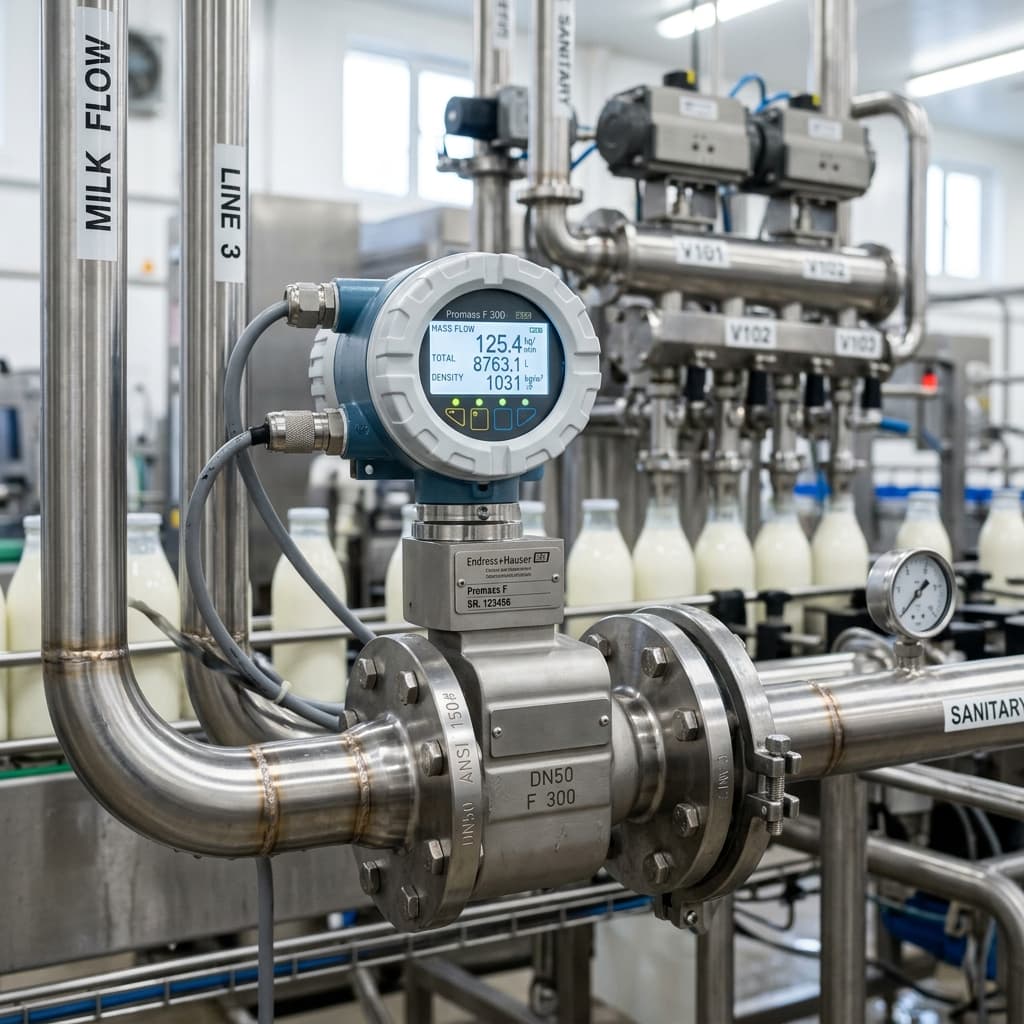
What is Flowmeter-Based Filling?
Traditional piston filling machines are mechanical; they draw liquid into a cylinder and push it out. However, for high-capacity products requiring ultra-hygiene—such as milk, liquid oils, lubricant oils, and chemicals—mechanical parts can be a disadvantage.
Flowmeter systems use electronic sensors instead of mechanical pistons to measure the amount of liquid instantaneously. When the nozzle opens, the liquid begins to flow; once the target value is reached (for example, exactly 1,000 ml or 900 grams), the valve closes within milliseconds.
Two primary types of flowmeters are used in the industry: Magnetic and Mass (Coriolis).
1. Magnetic Flowmeters (Mag-meter)
These operate based on Faraday's law of electromagnetic induction.
- How It Works? A magnetic field is applied to the liquid passing through the pipe. The faster the liquid flows, the higher the voltage produced. By measuring this voltage, the "Volume (Liter/Milliliter)" of the liquid is calculated.
- Requirement: The liquid must be conductive to electricity.
- Where Is It Used? It yields excellent results for water-based (conductive) products such as milk, fruit juice, ayran, turnip juice, water, and shampoo.
- Disadvantage: It cannot measure non-conductive liquids like pure water (RO), olive oil, or mineral oils.
2. Coriolis Mass Flowmeters
This is the most precise measurement technology in the world. Instead of measuring the volume (Liter) of the liquid, it directly measures its "Mass (Kilogram/Gram)."
- How It Works? There are vibrating tubes (U-shaped or straight) inside the pipe. As the liquid passes through these tubes, it creates a twist known as the "Coriolis force." This twist is measured instantaneously to determine the weight of the product.
- Where Is It Used? Olive oil, sunflower oil, engine oil, syrup, honey, and dense chemicals.
- Advantage: In volumetric filling (Liters), liquids expand when the temperature changes, leading to inaccuracies. However, 1 Kilogram of oil is always 1 Kilogram, whether the temperature is 10°C or 90°C! Therefore, Mass Flowmeters are 100% immune to temperature fluctuations and eliminate product giveaway ($\pm$0.1% accuracy).
Frequently Asked Questions (FAQ)
Q: Are flowmeters damaged during the CIP (Cleaning-in-Place) process? A: No, quite the opposite! Since there are no moving mechanical parts (such as pistons or o-rings), CIP chemicals flow rapidly through the pipe without any obstruction, ensuring 100% hygiene. (EHEDG certified).
Q: Why are flowmeter filling machines more expensive? A: A separate electronic sensor (Krohne, Endress+Hauser, etc.) is required for each filling nozzle. Although the initial investment cost is higher, it pays for itself within a year in large-capacity plants by reducing "Give-away" (overfilling errors) to nearly zero.
As Dr Mach, we offer zero waste and maximum capacity for your milk and liquid oil projects with our fully electronic Flowmeter Filling Monoblocks powered by Endress+Hauser infrastructure.