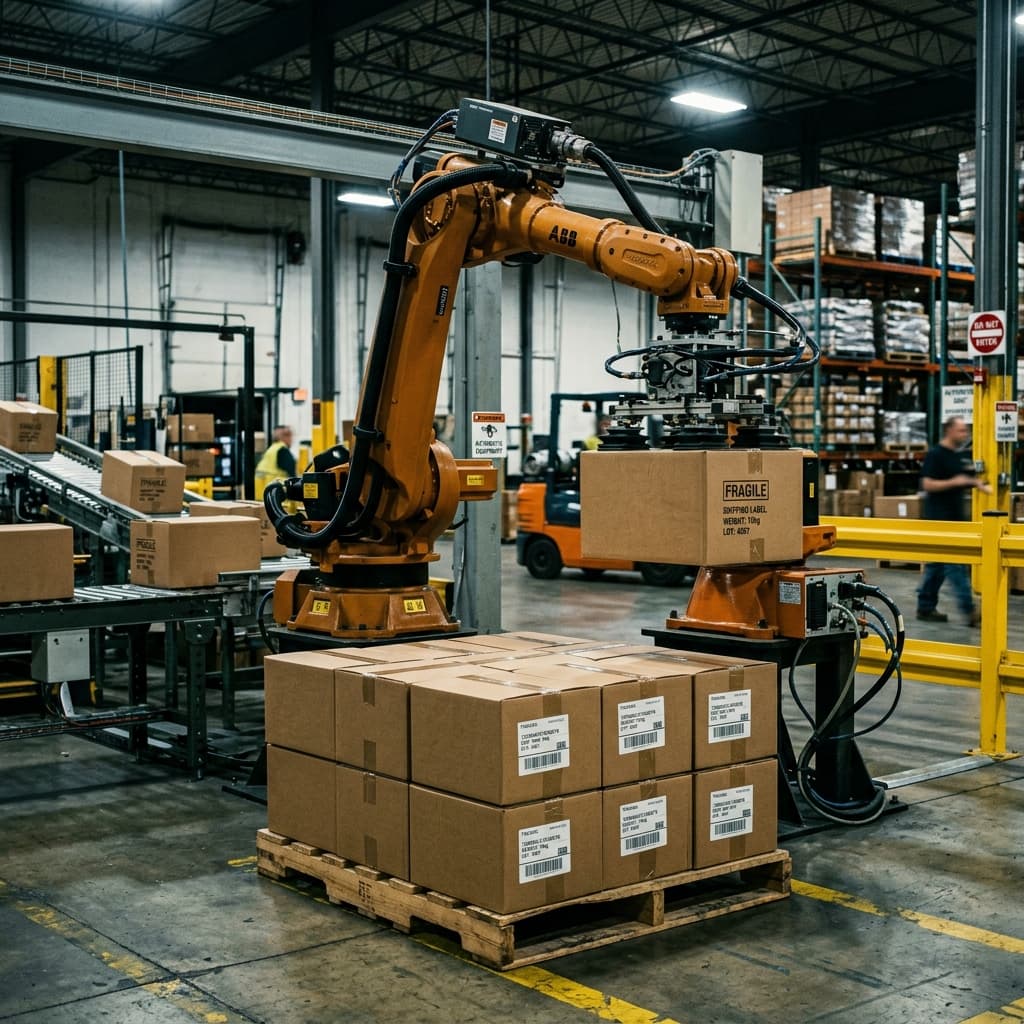
The Importance of Palletizing Automation
You can perform the production, filling, labeling, and casing stages of a product with the world's fastest machines (10,000 units per hour). However, when it comes to stacking these cases onto pallets for the logistics warehouse; if you perform this process manually, you create a serious "bottleneck" in your factory.
In terms of Occupational Health and Safety (OHS), stacking 10-20 kg boxes on top of each other for 8 hours a day leads to ergonomic injuries and herniated discs. This is where Palletizing Robots (Palletizers) take over this tedious, repetitive task that often clogs the end of the production line.
Types of Palletizing Systems
-
Conventional (Layer) Palletizers: Boxes align on a wide table. Once the entire layer (e.g., 10 boxes) is complete, the machine's elevator lowers the whole layer onto the pallet simultaneously. This is the most suitable solution for single-type and very high-speed productions (e.g., cement, flour bags, water cases).
-
Articulated Robotic Arm Palletizers: These consist of massive industrial robot arms (ABB, KUKA, FANUC) with 6 or 4 axes, equipped with specialized end-effectors (Grippers).
- Advantage: They are highly flexible. A single robot can take boxes of three different sizes coming from three different production lines and stack them onto three different pallets according to the patterns stored in its memory (Multi-line palletizing).
Robot Gripper Designs
Grippers, which act as the "hand" of the robot, are specially designed based on the product:
- Vacuum Grippers: Use suction to transport flat-surfaced, leak-proof cardboard boxes and buckets.
- Fork Grippers: Provide support from underneath for bags or shrink-wrapped packs (e.g., 6-pack water) that require bottom entry.
- Clamp Grippers: Ideal for sturdy plastic crates that need to be gripped by squeezing from the sides.
The Final Step: Stretch Wrapping Machine
After the robot stacks the pallet perfectly (interlocked like bricks), the load must be secured to prevent it from tipping during logistics shipment. The full pallet moves automatically via roller conveyors to the Stretch Wrapper. The machine's rotating tower or turntable stretches and wraps nylon film around the pallet, cuts it, and makes it ready for transport.
Frequently Asked Questions (FAQ)
Q: Why are boxes stacked in an overlapping pattern on the pallet? A: Just as masons lay bricks in a staggered/overlapping manner rather than directly on top of each other, robotic palletizers stack boxes in an interlocking pattern (thanks to software algorithms). This eliminates the risk of the pallet collapsing during vibrations during truck transport.
Q: Can palletizing be done with a Cobot (Collaborative Robot)? A: Yes, this is a recent trend. Since Cobots do not require safety fencing around them, they can work side-by-side with humans in tight spaces. However, their payload capacity is lower than that of giant industrial robots (Maximum 20-30 kg).
Dr Mach transforms your factory output points into autonomous logistics centers. Prevent workplace accidents and increase your shift capacity by 300% with our smart conveyor networks and 4-6 axis Robotic Palletizing systems.