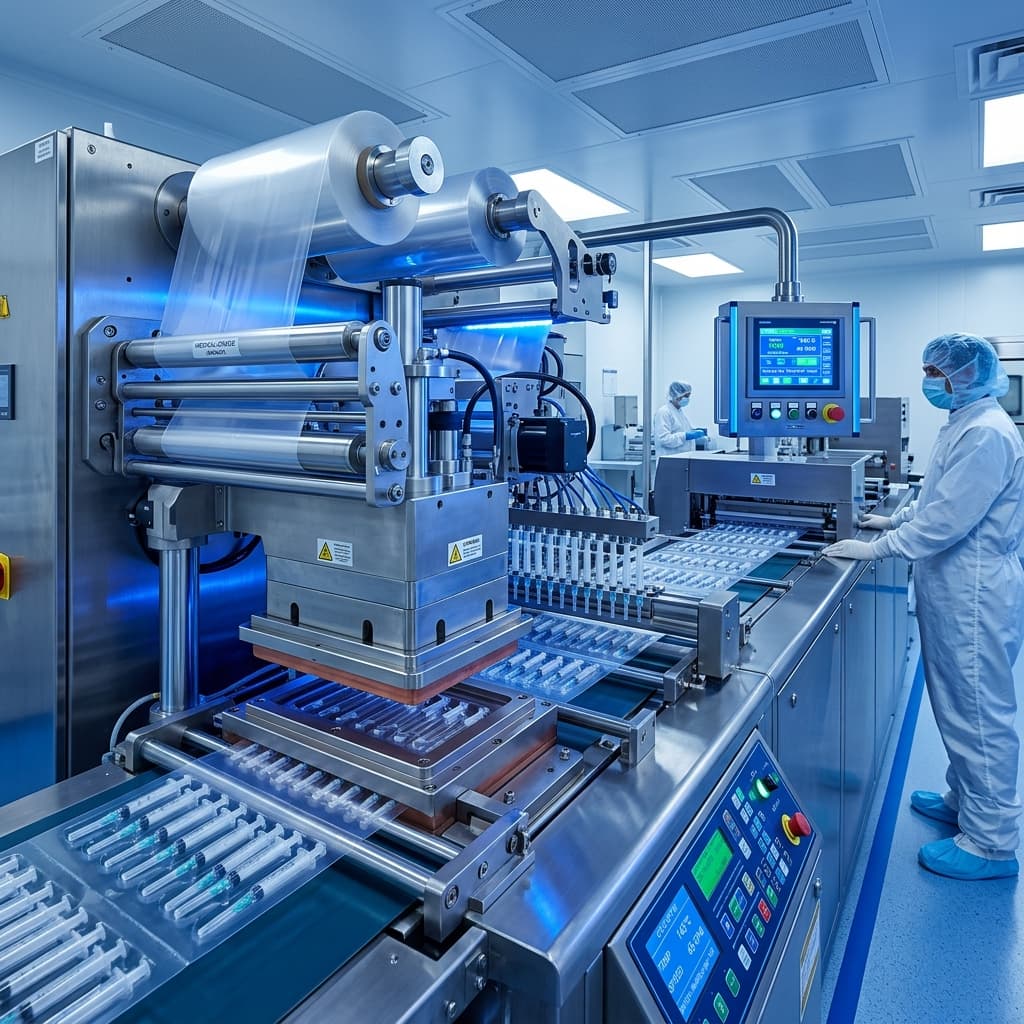
What is Thermoforming Packaging?
If you look closely at the packaging of sausages or kashar cheese on supermarket shelves, or syringes and scalpels in hospitals; you will notice that the part containing the product is shaped like a plastic "cavity," while the top is sealed with a flat film.
Instead of using pre-made trays, we call the massive machines that produce their own packaging trays by "heating and vacuuming" plastic drawn from a roll (Deep-draw) Thermoforming Packaging Machines.
The 4 Main Working Stations of the Machine
Thermoforming lines are modular, and the process of a product entering one end of the conveyor and exiting packaged at the other occurs in these steps:
- Forming Station: The thick (bottom) foil is heated using heating elements. Once the foil softens, it is pushed into the die using vacuum or compressed air to take the shape of the product (the tray form).
- Loading Station: Meat, cheese, or medical supplies are placed into the formed empty trays manually or via robotic arms.
- Sealing Station: A thin top web (lidding film) is applied from above. If it is a food product, Modified Atmosphere Packaging (MAP) gas is injected, and the top film is heat-sealed to the bottom layer.
- Cutting Station: The connected packages are separated by guillotine and roller knives to exit production as individual units.
Difference Between Rigid and Flexible Film
- Rigid Film Usage: The formed packaging does not stretch; it is tray-like. Generally, APET, PVC, or PP with a thickness of 300-1000 microns is used. It is suitable for toothbrushes, sliced cheese, or medical devices (Blisters). It protects the product against crushing.
- Flexible Film Usage: The formed packaging is flexible and resembles a plastic bag. Generally, PA/PE films with a thickness of 60-200 microns are used. It is ideal for vacuum-wrapping products like sausages, salami, or frozen fish (Skin pack).
Medical Thermoforming (Cleanroom Integration)
Unlike food machinery, thermoforming machines that package medical devices (syringes, catheters, needles) are manufactured to comply with ISO Class 7/8 "Cleanroom" standards. HEPA filters for air particle retention, sterilization papers (use of Tyvek top film), and the special chamfered design of stainless steel—which prevents microbes from harboring—are fundamental requirements for medical packaging.
Frequently Asked Questions (FAQ)
Q: Which is more advantageous, Thermoforming or Tray Sealing? A: For high-capacity production (e.g., 50,000 packages per day), Thermoforming is much more advantageous because you don't purchase pre-made trays; you produce the tray cheaply from a roll. However, for lower capacities and frequent changes in packaging shape (e.g., 5,000 packages per day), Tray Sealers are more flexible.
The Dr Mach Thermoform series—MAP compatible to prevent food waste and FDA approved for medical use—increases your production speed while slashing your packaging costs.